The Limiters: Continuing the Work the Founders Began -
A Practical
Amendment to Restore Balance and Accountability
Why Now?
-
Federal debt exceeds $38 trillion,
projected to surpass $100 trillion by 2050.
-
Interest payments consume
3–4% of total U.S. income and rising.
-
Social Security becomes insolvent
before 2033.
Learning From the Past
In the late 1700s, the Anti-Federalists—the original
Limiters—warned that the Constitution lacked explicit limits on
federal taxing and spending. That omission helped create today’s fiscal
crisis. The Limits Amendment addresses the flaw directly.
Before diving into the solution, consider the 1913 Income Tax Amendment
(16th Amendment, or 16A). Courts held that it did not
create new taxing powers; Congress already had authority to tax incomes.
The real debate was always about scope:
-
Must taxes on labor or property income be apportioned
as direct taxes?
-
Must income have a federal nexus (license, privilege,
or condition) to be taxed as an indirect tax?
Move Forward or Die
Whatever the arguments were before 16A, they became irrelevant after
ratification. Yet tax protesters still recycle old claims as if courts and
legislatures have forgotten history. The reality is simple: once
ratified—even if imperfect—16A is the law of the land.
There is no constitutional mechanism for officials to “decertify” it.
Change comes only from the People, moving forward through
amendment—not by judges unraveling the past.
What does “move forward” mean? Look to Prohibition (1920s-30s): the 21st
Amendment repealed the 18th, but it did not erase it. If “un-ringing the
bell” were possible, that would have been the moment—especially for a
public with a strong understanding of civic duty.
Let’s Break the Amendment Down.
-
Leashes the 16th Amendment by
narrowing its broad taxing power while keeping it
intact.
-
Anchors all federal taxing and spending to the
National Median Household Income (NMHI) to link fiscal
policy to family prosperity (“general Welfare”).
-
Bans federal taxes on interpersonal property transfers,
including gifts and inheritances.
-
Exempts all incomes below 2× NMHI from
an income tax, protecting working and middle-income
families.
-
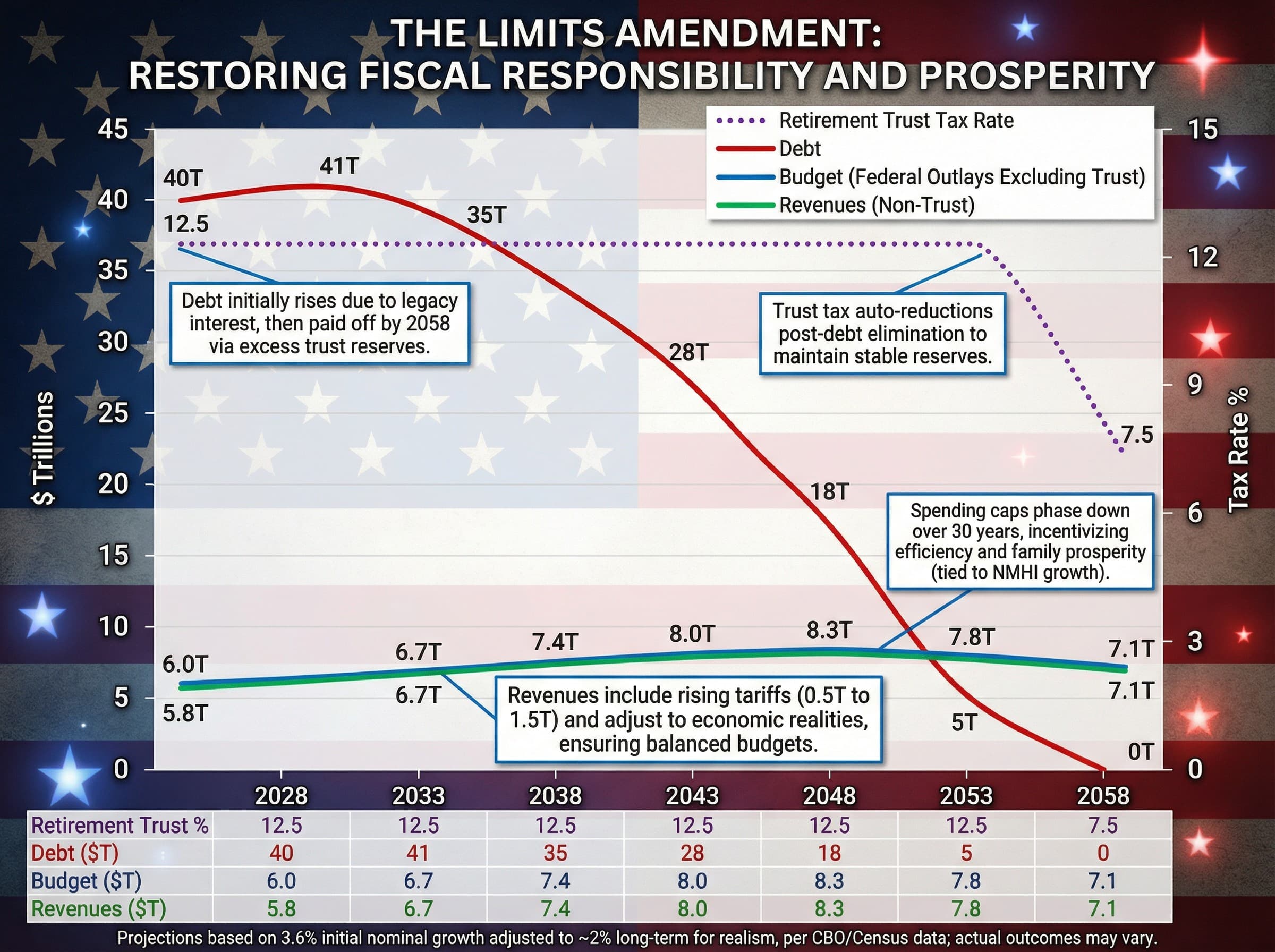
Establishes a 12.5% retirement tax on
all incomes to fund a universal retirement trust that pays equal
benefits at age 68 and automatically adjusts down after the national
debt is eliminated.
-
Uses the retirement trust excess to
pay off the national debt by 2058.
-
Phases federal spending down to
1980s levels by 2058 to achieve a
balanced budget.
-
Allows an emergency override only for
declared wars.
-
Aligns government incentives with rising family
incomes, encouraging policies that strengthen household prosperity.
Why It Works
-
Ties taxes and spending to family well-being, forcing
government to promote prosperity.
-
Pays off the national debt, secures retirement, and
ends uncontrolled spending growth.
-
Follows the model of the 1930s repeal of Prohibition:
forward action by the People—not politicians.
Why You?
- The Constitution cannot defend itself.
-
Become a Limiter—educate, advocate, and mobilize.
The Limits Amendment is not radical; it is restorative. By refining rather
than repealing, it charts a pragmatic path forward. Ready to limit
government and unleash American potential? Your voice drives ratification.
Join fiscal reform discussions, contact representatives, or organize
petitions. Be a Limiter.
The Text
The Limits Amendment puts a leash on 16A with permanently self-adjusting
limits tied to the
National Median Household Income (NMHI), around $85,000:
-
Section 1. No tax, duty, impost, or excise shall be
imposed on the transfer of real or personal property between natural
persons.
-
Section 2. No tax, duty, impost, or excise shall be
imposed on the income of any natural person below an amount equal to
twice the national median household income, except as authorized in
Sections 3 and 5.
-
Section 3. Congress may levy taxes, duties, imposts, or
excises on all incomes at a rate not to exceed twelve and one-half
percent (12.5%) for the sole purpose of funding an irrevocable trust
dedicated to providing equal monthly retirement benefits.
-
(a) Levies authorized in this Section shall be imposed solely to
fund the trust described herein, except as provided in subsections
(e) and (f).
-
(b) The trust shall pay monthly benefits to each natural person at
least sixty-eight years (68) of age who has earned, over any
twenty-year (20) period, total income of at least five (5) times the
national median household income. The monthly benefit shall equal
one-third (1/3) of the national median household income.
-
(c) The trust shall be invested in diversified, low-risk,
income-producing assets to ensure long-term stability and growth.
-
(d) Trust reserves shall not exceed one-hundred-fifty percent (150%)
of annual projected benefits, nor fall below seventy-five percent
(75%) of annual projected benefits.
-
(e) Trust reserves in excess of one-hundred-fifty percent (150%) of
projected benefits shall first be applied to reduce the principal of
debt held by the public until such debt is eliminated, and this
authority shall terminate upon its elimination. Thereafter, excess
reserves shall automatically reduce the tax rate authorized in this
Section to maintain reserves not exceeding one-hundred-fifty percent
(150%) of projected benefits.
-
(f) If reserves fall below seventy-five percent (75%) of projected
benefits, the tax rate authorized in this Section may be increased
temporarily by up to two (2) percentage points for no more than five
years (5) upon a two thirds (2/3) vote of both Houses of Congress.
-
Section 4. Total federal outlays, excluding outlays
from the trust established in Section 3, shall not exceed one half (1/2)
of the national median household income multiplied by the number of
households in the United States. This limit shall be reduced by one
one-hundredth (1/100) each fiscal year over thirty years (30) until it
reaches one fifth (1/5) of the national median household income
multiplied by the number of households, which limit shall thereafter be
permanent, except as provided in Section 5. During the phase-down
period, Congress may allocate transition grants to the states not
exceeding ten percent (10%) of the annual reduction in the spending
limit.
-
Section 5. Only the limitations in Sections 2 and 4 may
be suspended temporarily by a two-third (2/3) vote of both Houses of
Congress upon a declaration of war, solely for the purpose of providing
for the common defense.
-
Section 6. The “national median household income” and
“number of households” shall be determined annually by the Census Bureau
or its lawful successor.